Healthy animals, responsible medicines: livestock farming's contribution to the One Health strategy
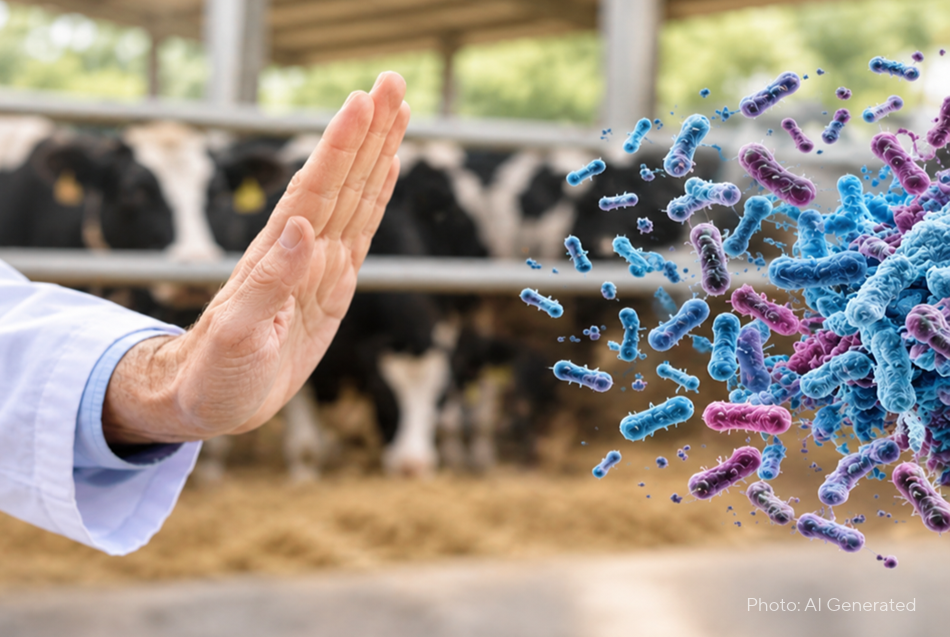
Prevention, biosecurity and prudent use of antimicrobials: how livestock farming helps tackle antimicrobial resistance and strengthen the health of animals, people and the environment under the One Health approach.
Every year, from 18 to 24 November, World AMR Awareness Week (WAAW) draws attention to one of the major health challenges of our time: antimicrobial resistance (AMR). The theme of WAAW 2026 highlights an essential principle: the health of people, animals, and the environment is closely interconnected, and it calls on every sector to take concrete action. The campaign, jointly signed by the World Health Organization (WHO), FAO, the United Nations Environment Programme (UNEP) and the World Organization for Animal Health (WOAH), explicitly names farmers and veterinarians. The new Global Action Plan on AMR 2026-2036 includes reducing antimicrobial use in agrifood systems as an objective.
Briefly, AMR occurs when bacteria, viruses, fungi and parasites no longer respond to the medicines used to fight them. As a result, infections become harder to treat, and the risk grows that diseases treatable today will once again become a serious threat. This is a concern for society as a whole, not just one sector. In this scenario, livestock farming also plays an important role in tackling it. Keeping animals healthy, preventing disease, and using veterinary medicines responsibly helps reduce the need for treatment and preserve the effectiveness of antimicrobials for the future.
Prevention is the first step against antibiotic resistance
Responsible use of antimicrobials does not mean giving up on treating animals. When a bacterial infection is diagnosed, appropriate treatment can be essential to protect their health and welfare. Leaving a sick animal untreated would be neither ethical nor compatible with responsible food production. The priority, however, must be to prevent animals from falling ill whenever possible. This requires an integrated strategy based on biosecurity, vaccination, hygiene, balanced nutrition, adequate environments and constant monitoring of health status.
Selecting robust animals, properly managing stocking densities and the microclimate, and continuously training farmers also matter. These measures do not act separately: together they make farms better able to prevent and cope with disease. Healthy animals are less likely to contract and spread infections and, consequently, need antimicrobial treatments less often. Prevention is therefore the meeting point between animal welfare, sustainability and the fight against AMR, and investment in improving it must continue.
Using fewer medicines, but above all using them better
When an antimicrobial is necessary, it must be used under close veterinary supervision, after an adequate clinical assessment and, where possible, based on diagnostic tests. The choice of medicine, dose, and duration of treatment must match the characteristics of the infection and the animal. Responsible use means avoiding unnecessary treatments, respecting the prescription and resorting to antimicrobials considered critical for human medicine only when genuinely indicated. It also means collecting data, monitoring medicine use, and tracking the possible emergence of resistance. Europe has already made significant progress. Between 2011 and 2022, sales of veterinary antibiotics fell by 53% in the countries that continuously participated in European monitoring. The latest European Sales and Use of Antimicrobials for Veterinary Medicine (ESUAvet) report, published by the European Medicines Agency (EMA) in December 2025, also deserves attention. It recorded a 5.1% increase in antibiotic sales for food-producing animals in 2024 compared with 2023. This slight uptick should, however, be interpreted with caution. The report points to several possible contributing factors, including medicine availability and stockpiling, disease outbreaks and changes in animal populations. In some countries, more complete reporting and changes in data collection systems have also influenced the figures. Importantly, the overall picture remains encouraging when it comes to the use of antibiotics of greatest importance for human medicine: AMEG category B antibiotics, classified as ‘Restrict’, accounted for just 6% of total sales for food-producing animals across the EU, while 94% fell into categories C and D, which carry lower risks to human health. The report also provides more detailed data on actual use by animal species, although differences in national coverage and data quality mean that EU-wide comparisons are not yet possible. The next ESUAvet report, expected in December 2026, should provide further insights into these trends.
However, sales do not reflect actual use, as a medicine that is sold may remain in storage. This is why the EMA has made data on use by animal species and subcategory mandatory since 2024. This is where the electronic prescription comes in. It is the lever that moves surveillance from what is sold to what is prescribed and used. Italy is a forerunner: the veterinary electronic prescription has been mandatory since 16 April 2019, and the EMA cites the country among those whose 2024 results reflect improved data accuracy, supported by electronic prescribing and digital surveillance systems. The last mile remains administration, because “prescribed” does not yet mean “actually administered”. In 2023-2024, several countries collected use data by filling in farm registers by hand: a method closer to the field than sales declared by manufacturers, but still laborious. This is why European surveillance has not yet reached the finish line: once this step is completed, with electronic treatment registers and electronic prescribing widespread in all countries, measured consumption will probably be lower than current sales suggest, because unsold stock and uncompleted prescriptions will disappear from the count.
One Health, shared responsibility: protecting animals to strengthen the food system
AMR knows no borders between hospitals, farms, communities and ecosystems. Resistant microorganisms and residues circulate through people, animals, food, water and the environment. No sector can tackle the problem alone: the One Health approach connects doctors, veterinarians, farmers, researchers, public authorities and environmental specialists. Surveillance must integrate data from human and veterinary medicine, and prevention measures must cover the entire supply chain, from animal health to wastewater management, through to the proper disposal of medicines. For the livestock sector, contributing to One Health means not only producing while keeping animals healthy, but also working with veterinarians, adopting farm health plans, applying biosecurity protocols, and using medicines based on diagnoses and real needs.
A farm that prevents disease is also more resilient. It reduces production losses, limits the spread of infections, protects animal welfare and contributes to the continuity of food supply. Animal health is therefore not an element separate from food safety: it is one of its foundations. The European Union aims to halve, by 2030, total sales of antimicrobials for farmed animals and aquaculture, compared with 2018. It should also be stressed that while sales of veterinary antibiotics in Europe have fallen by more than half, over the same years consumption in human medicine did not follow the same trajectory: it remained broadly stable and, in some countries, grew. This gap signals how livestock farming has reformed faster than other fields, where inappropriate antibiotic use, prescriptions without diagnosis, antibiotic therapies for viral infections, and doses and durations not respected remain open problems. Fighting AMR does not mean setting human health against animal health. It means recognising that protecting one helps protect the other. If resistance generated in one sector spills over into the other, then the merit of one sector can also point the way for the other. Healthy animals, responsible farms, and prudently used veterinary medicines are therefore part of the same solution: a safer, more sustainable, and more resilient food system built on the principles of One Health.
1. Why does the World AMR Awareness Week matter for livestock farming?
World AMR Awareness Week (WAAW) runs from 18 to 24 November and is jointly led by the WHO, FAO, UNEP and WOAH. The 2026 theme, “One Health, one action: Prevent AMR now”, explicitly names farmers and veterinarians among the actors asked to take concrete action, and the Global Action Plan on AMR 2026-2036 sets reducing antimicrobial use in agrifood systems as one of its objectives. For the livestock sector, that means healthy animals and responsible medicine use are not a side issue but a recognised part of the global response.
2. What is the difference between antibiotic sales and actual antibiotic use in animals?
Sales measure how much veterinary antimicrobial product is distributed, not how much is administered. A medicine that is sold may sit in storage, and aggregate sales figures cannot distinguish dairy cows from calves or sows from fattening pigs. That is why the European Medicines Agency (EMA) describes sales as a reliable proxy rather than a direct measure of consumption, and why the EU has made reporting on actual use, broken down by animal species and subcategory, mandatory since 2024.
3. How does the electronic veterinary prescription improve the monitoring of antimicrobial use?
The electronic veterinary prescription moves surveillance from what is sold to what is prescribed, creating a traceable record for each treatment. Italy has required it since 16 April 2019, and the EMA cites the country among those whose 2024 results reflect improved data accuracy supported by electronic prescribing and digital surveillance systems. The final step is administration: reaching actual use requires electronic treatment registers.
4. Has livestock farming reduced its antibiotic use faster than human medicine?
Yes, in the same direction. Between 2011 and 2022, sales of veterinary antibiotics fell by 53% in the countries that reported continuously to European monitoring, while consumption in human medicine over the same period remained broadly stable and even grew in some countries. The divergence in trajectory is clear: livestock farming has reformed faster than other fields, where inappropriate antibiotic use remains an open problem.