Europe should stop looking at livestock only through the climate lens
The new European livestock strategy marks a paradigm shift: not by denying the environmental impact of livestock farming, but by recognising that its value to Europe cannot be measured solely in tonnes of CO₂ equivalent.
For years, the European debate on livestock farming has focused primarily on the question, “how much does livestock farming pollute?” But with the first EU Livestock Strategy, presented on 7 July 2026, the European Commission acknowledges that this perspective is not enough to define the sector’s future.
Livestock farming is now considered a strategic component of the European food system, linked not only to sustainability, but also to food security, strategic autonomy, competitiveness, employment, rural areas, biodiversity, landscapes, resilience and the bioeconomy. This raises a broader and deliberately provocative question: what would Europe lose if livestock farming were drastically reduced or disappeared from a significant part of its territory? It is an essential question if we are to address sustainability in a genuinely comprehensive way.
From “how much does it emit?” to “what does it produce?”
An agricultural system cannot be assessed through a single indicator. Livestock farming produces not only meat, milk, eggs and other nutrient-dense foods, but also generates economic value, employment and territorial functions that cannot be reduced to an emissions balance. The Commission’s figures confirm its importance: around 4 million farms, 7 million jobs and €400 billion in annual turnover, representing almost 40% of European agricultural value added. In 2025, animal products also generated around €53 billion in exports, compared with €16 billion in imports. Behind these figures lies a complex value chain involving farms, processing, feed production, veterinary services, transport, the food industry, research and trade, supporting entire local economies. For this reason, reducing livestock farming would not only have production-related consequences, but could also weaken the economic and social fabric of many rural areas.
Livestock farming as food security infrastructure
One of the most significant aspects of the new European strategy concerns food security. A resilient food system cannot rely solely on crop production, because livestock farming makes it possible to transform resources that humans cannot directly consume into food. According to a study conducted by FAO researchers and published in Global Food Security, around 86% of feed destined for livestock is not suitable for human consumption, while 57% of land used for grazing is not suitable for crop production. For this reason, simply arguing that animals “compete with humans for food” oversimplifies the issue. Through forage, by-products and non-edible biomass, livestock can transform otherwise unusable resources into foods with high nutritional value. The relationship between livestock, feed, soil and land must therefore be assessed case by case, taking into account the characteristics of different production systems.
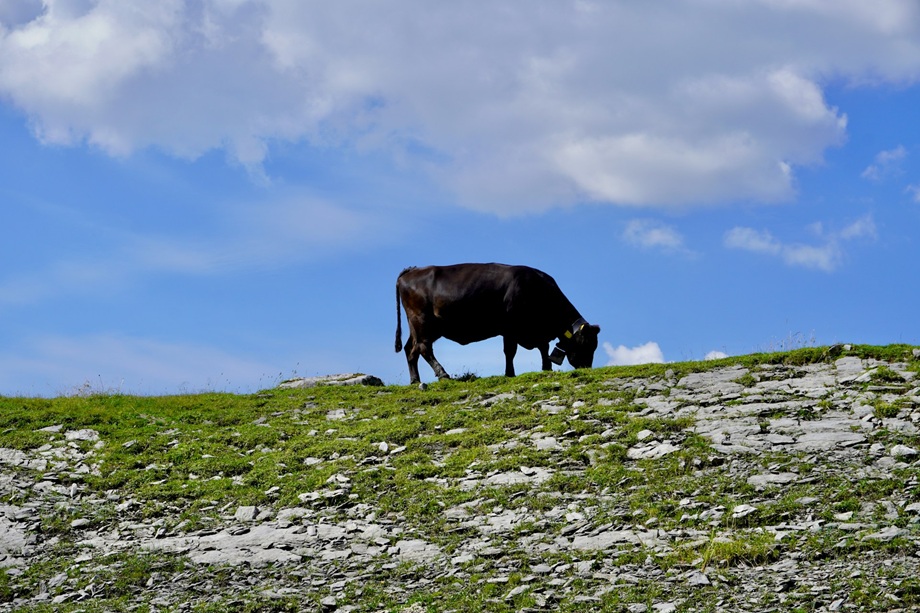
The role of livestock farming becomes particularly clear in mountainous, hilly and marginal areas, where growing cereals or other crops can be difficult or impossible and grazing often represents one of the few ways of using the land for agricultural purposes. Grazing also plays a role in landscape management and the conservation of certain habitats, helping in some circumstances to maintain open grasslands and pastures and limit the spread of shrubs.
However, the relationship with biodiversity and the environment depends on proper management, grazing pressure and the characteristics of the territory. It is therefore necessary to move beyond the “livestock farming yes or no” debate and ask which type of livestock farming best suits each territory, with which practices, stocking densities, and objectives, while avoiding policies that penalise extensive systems whose territorial functions are difficult to replace.
From manure to the circular bioeconomy
Manure is another example of why assessing livestock farming solely through the lens of emissions is reductive. When properly managed, it can return nitrogen, phosphorus, potassium, and organic matter to the soil, supporting soil fertility and reducing dependence on mineral fertilisers. The European Commission is promoting nutrient recovery and the use of fertilisers obtained from manure treatment, such as RENURE, as part of a circular economy approach.
This perspective places livestock farming within the broader bioeconomy, where manure, biomass and by-products can also be used to produce energy and other materials. Livestock farming thus becomes an integral part of an interconnected system involving agriculture, soil fertility, feed production, energy, the food industry, rural employment and innovation. Its value therefore becomes fully apparent when the entire agri-food system is considered rather than a single component.
Strategic autonomy and dependence on imports
Another strategic issue concerns Europe’s dependence on agricultural inputs from outside the EU, particularly protein sources used in animal feed. According to the Commission, 74% of high-protein oilseed meals and protein crops used in the EU are imported. The answer is not to reduce livestock farming, but to strengthen European plant-protein production, diversify sources, develop local feed supplies, and better integrate crop and livestock production, as also envisaged by the Protein Action Plan. A reduction in European livestock production, accompanied by increased imports, could shift production and associated environmental pressures outside the EU without delivering a genuine global climate benefit, while also increasing Europe’s dependence on foreign supply chains.
If European livestock farming were drastically reduced, the consequences would extend far beyond lower production of animal-based foods. Jobs, economic value, rural communities, pasture and nutrient management, and the ability to valorise biomass and by-products could all be affected. This is why the EU Livestock Strategy points towards a different approach: producing better through innovation, digitalisation, genetics, more efficient animal nutrition, nutrient management, climate adaptation, European plant proteins, the circular economy and improved animal welfare. Sustainability, therefore, cannot be measured solely by emissions.
- What is the main change introduced by the EU Livestock Strategy?
The EU Livestock Strategy moves beyond a climate-only assessment, recognising livestock farming’s role in food security, rural economies, biodiversity, resilience and strategic autonomy.
- Why is livestock farming important for European food security?
European livestock farming converts forage, by-products, and other resources unsuitable for human consumption into nutritious food, while using grasslands and land unsuitable for crops.
- How does livestock farming contribute to the circular bioeconomy?
Livestock provides manure and other by-products that can return nutrients to soils, reduce dependence on mineral fertilisers and support a more circular European agri-food system.
- Does the EU strategy call for reducing livestock farming?
No. It focuses on producing better, through innovation, improved efficiency, European plant proteins, climate adaptation, circularity and higher animal welfare, rather than simply producing less.