Beyond the “carbon tunnel vision”: the debate on meat and sustainability deserves more scientific honesty
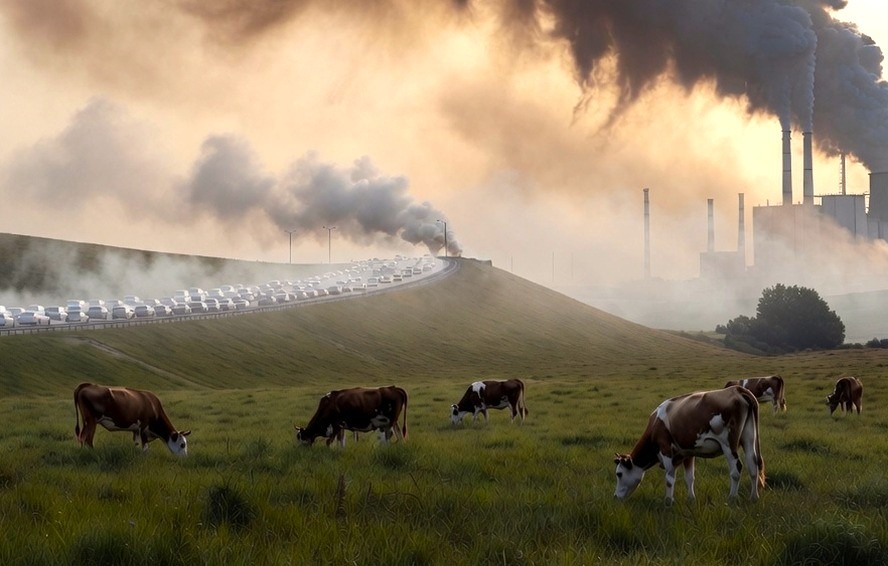
Reducing meat consumption will not solve the climate crisis. That is the conclusion emerging from a new review that calls for moving beyond a narrow and ideological perspective, the so-called “carbon tunnel vision”, and approaching sustainability through a broader scientific lens.
Livestock farming is often portrayed as one of the main drivers of greenhouse gas emissions, with reducing meat and animal-source foods frequently proposed as the primary solution to environmental problems. In reality, the issue is far more complex and deserves to be addressed without oversimplification. This is the focus of a new review published in Food Science of Animal Resources, which encourages a more scientifically grounded discussion of sustainability. Among the authors are internationally recognised experts such as Frédéric Leroy, Ty Beal, and Frank Mitloehner. They criticise what they call “Carbon Tunnel Vision”, a perspective that reduces food sustainability to greenhouse gas emissions alone while ignoring many other relevant dimensions.
The real contribution of livestock to global emissions
One of the paper’s central points concerns the gap between public perception and actual data. Extremely inflated claims about the environmental impact of livestock are often circulated in media campaigns and social networks. Some activists even suggest that more than 50% of global emissions come from livestock production. However, more recent and authoritative estimates indicate that the global livestock sector accounts for approximately 12% of total anthropogenic GHGs emissions. Western livestock systems, including those in Europe, North America, Australia, and New Zealand, are estimated to account for only 2.6% of total global emissions. For the European Union alone, the figure drops to roughly 1%. These numbers substantially challenge the idea that Western livestock farming is a major driver of climate change.
The authors also emphasise that there are enormous differences between production systems. One kilogramme of beef produced in Europe or North America generates significantly lower emissions than beef produced in less efficient systems found in parts of Sub-Saharan Africa or South Asia. Therefore, speaking generically about “meat” or “livestock” without distinguishing between production models is scientifically misleading.
Reducing meat consumption has a limited effect on personal carbon footprints
The review highlights that, in Western countries, reducing meat consumption generally lowers an individual’s total carbon footprint by only about 1–6%, confirming that the climate impact of diet is smaller than that of many other sectors. In particular, a fully vegan diet in the United States would reduce national greenhouse gas emissions by less than 3%, suggesting that dietary changes alone have a relatively modest impact compared to emissions from the broader economic system. In Western societies, the average annual carbon footprint is around 9–15 tonnes of CO₂ equivalent per person, while food contributes only about 1.5–2 tonnes. The rest primarily comes from transportation, housing, energy consumption, goods, and services.
The review also points out that food substitutions are not environmentally “neutral”. Replacing animal-source foods often requires increased use of fertilisers, changes in land use, and higher agricultural emissions, which can reduce the expected net environmental benefit. By comparison, living without a car can reduce emissions by approximately 1.0–5.3 tonnes of CO₂e per year, far more than eliminating meat. In comparison, a single intercontinental flight can emit between 0.7 and 2.8 tonnes of CO₂e, equivalent to several years of dietary “savings”. According to the authors, climate policies focused almost exclusively on diet risk being ineffective unless accompanied by interventions targeting energy systems, transportation, and infrastructure, which remain the dominant sources of emissions in wealthy countries.
“Alternative proteins” are not necessarily better
The review argues that environmental assessments of foods often focus almost exclusively on calories or protein quantity while neglecting important factors such as nutrient bioavailability, protein quality, and nutrient density. Animal-source foods provide highly bioavailable nutrients, including vitamin B12, heme iron, zinc, calcium, selenium, and essential amino acids. The authors warn that highly restrictive diets may increase the risk of nutritional deficiencies, especially among vulnerable groups, including children, pregnant women, women of reproductive age, and the elderly.
The paper also examines so-called “alternative proteins”, including plant-based burgers, mock meats, cultured meat, and isolated proteins, warning against overly simplistic assumptions. These products do not always have the low environmental impact often claimed, as they often rely on complex, energy-intensive industrial processes. Furthermore, some plant-based alternatives have lower nutritional quality than traditional animal foods, particularly in terms of protein quality and micronutrient bioavailability. The review also notes that many industrial plant-based meat substitutes fall into the category of ultra-processed foods, which have been associated with negative health outcomes. For this reason, the authors argue that food sustainability assessments should consider not only environmental emissions, but also overall nutritional value and the degree of industrial processing.
Lab-grown meat could have a higher impact than conventional livestock
The review is particularly critical of lab-grown meat. Some models cited in the paper suggest that, if produced using energy systems that are not fully decarbonised, cultured meat could have emissions comparable to, or even higher than, those of certain conventional livestock systems. The paper reports estimates for cultured meat averaging around 7 kg CO₂e per kilogramme of product, with a very wide range of approximately 3-25 kg CO₂e/kg. Compared with conventional livestock systems, poultry generally ranges from 2 to 7 kg CO₂e/kg, while pork ranges from 3 to 11 kg CO₂e/kg. This means cultured meat does not necessarily show a clear environmental advantage and often overlaps with conventional systems.
One study cited in the review even estimates that, when accounting for all industrial processes required for large-scale production, cultured meat emissions could be 4 to 25 times higher than those of conventional beef production. For this reason, the authors urge caution in evaluating these technologies, emphasising the need to consider not only their theoretical potential but also the actual industrial, economic, and energy conditions required for large-scale production.
The role of grasslands and carbon sequestration
The review points out that many environmental analyses focus mainly on animal emissions while overlooking the ecological role of grasslands in carbon sequestration and soil health. Grasslands cover nearly 50% of the Earth’s land surface and store approximately 10–30% of the planet’s soil organic carbon. Well-managed grazing systems, such as rotational and regenerative grazing, can promote carbon accumulation in soils by interacting among animals, vegetation, root systems, and soil microbiology. According to the studies cited, improved grasslands may sequester approximately 0.1–0.6 tonnes of carbon per hectare per year, while adaptive rotational grazing systems may reach around 2–3 tonnes per hectare annually, with extreme cases reaching up to 8 tonnes per hectare during the restoration of degraded land.
Some regenerative management practices may also increase livestock carrying capacity by 30–50% while simultaneously improving ecosystem functionality. The authors acknowledge that sequestration potential varies enormously depending on climate, soil type, ecosystem, and management practices, and that long-term studies are still needed to determine the extent to which these systems can offset livestock emissions. Nevertheless, they argue that ignoring the ecological role of grasslands leads to incomplete and potentially misleading conclusions.
Methane from cattle is not the same as CO₂ from fossil fuels
The review stresses that methane produced by ruminants behaves differently from fossil-fuel-derived CO₂. While CO₂ from coal, oil, and natural gas accumulates in the atmosphere for centuries, biogenic methane has a much shorter atmospheric lifespan, though it exerts a stronger short-term warming effect. For this reason, the authors discuss alternative climate metrics such as GWP*, which evaluates methane differently from the traditional GWP100 metric currently used in most climate policies. According to the review, GWP100 may overestimate the long-term warming impact of livestock methane by treating it too similarly to fossil CO₂.
The paper reports that a continuous annual reduction of approximately 0.3% in methane emissions could theoretically stabilise the livestock sector’s climate contribution. Some studies cited also show that, when using GWP* and accounting for carbon sequestration in grasslands, certain sheep production systems in New Zealand and Australia approach climate neutrality or even achieve a net-negative climate footprint, meaning they may absorb more greenhouse gases than they emit.
Sustainability cannot be achieved through simplistic or extreme measures
The authors warn that addressing food sustainability through drastic anti-livestock policies could generate unintended economic, social, and environmental consequences. Punitive meat taxes, forced herd reductions, or universal dietary restrictions ignore the profound differences in agriculture, ecology, culture, and economics across global food systems. The review highlights the risk of “carbon leakage”, meaning the relocation of production to countries with lower environmental standards and less efficient systems, potentially increasing global emissions rather than reducing them. Other possible side effects include rural abandonment, biodiversity loss in traditional agricultural landscapes, greater dependence on ultra-processed foods, and nutritional concerns associated with overly restrictive dietary strategies.
Instead, the authors advocate a more pragmatic, science-based approach focused on improving production efficiency, integrating crop and livestock systems, developing agroecological and silvopastoral systems, reducing food waste, and valorising agricultural by-products. Technological innovation is also presented as a key tool for reducing emissions without compromising food security, nutritional quality, or the economic stability of rural communities. The final message of the review is that food sustainability cannot be reduced to a single parameter or to simplistic slogans such as “meat versus no meat”. Emissions, nutrition, biodiversity, soil fertility, human health, and rural economies all require balanced scientific evaluation. The authors therefore call for moving beyond what they describe as “Carbon Tunnel Vision”, an excessively narrow focus on emissions alone, and toward a more comprehensive understanding of food systems and sustainability.