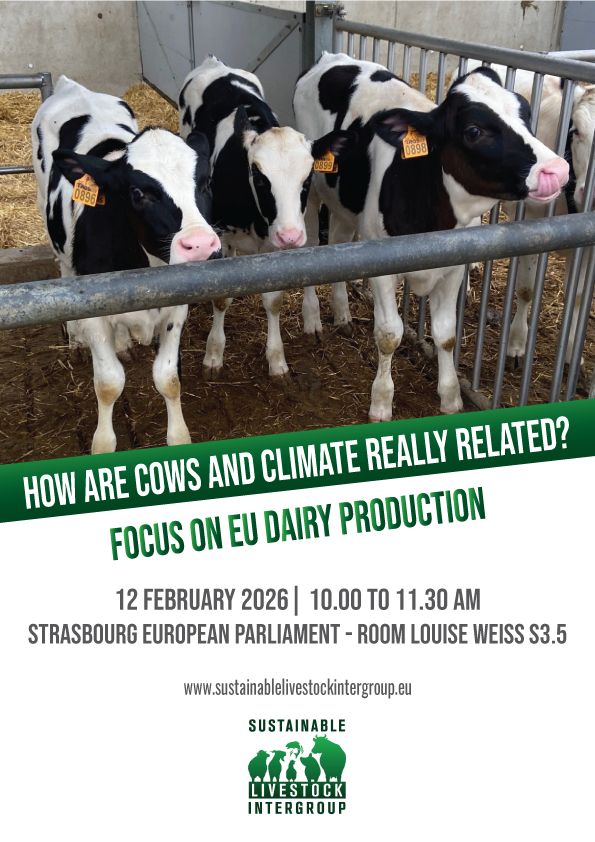
Cows and climate: a complex relationship, too often oversimplified
In recent years, the public debate around meat, milk and climate change has become increasingly heated. On the one hand, livestock farming is portrayed as one of the main drivers of greenhouse gas emissions; on the other, some argue that feeding the world without livestock would be impossible and that the role of cows and cattle in the climate debate is widely misunderstood. The truth, as is often the case, is neither black nor white, but a complex relationship that requires data, context and a science-based approach.
Progress in reducing emissions through innovation
Livestock farming indeed contributes to greenhouse gas emissions, particularly through methane, a very powerful gas produced during the digestion of ruminants such as cows, sheep and goats through a process known as enteric fermentation, and released mainly through belching.
However, the simple equation “more cows = more warming” does not tell the whole story. There are four main sources of emissions associated with livestock farming that need to be considered together: feed production and transport, land-use change, enteric fermentation in animals, and manure management. By addressing these areas through practices such as more efficient feeding, improved animal health management, and the use of precision technologies in production, the European Union has achieved a significant reduction in methane emissions from the livestock sector in recent years, even as production has remained stable or even increased.
In the dairy sector alone, for example, total methane emissions from livestock have decreased by around 21% since 1990, despite continued production. Milk and dairy products remain essential to the European diet, providing high-quality protein, calcium and vital micronutrients. This shows that achieving climate progress does not require a drastic reduction in animal numbers: efficiency can be improved and environmental impacts reduced through science-based, innovative strategies.
Reducing emissions through a transition towards more efficient models
The key challenge today is how to further reduce the climate impact of milk and meat production while maintaining farm competitiveness and the sector’s productive capacity. The aim is not to deny the existence of emissions, but to understand how the livestock sector can contribute constructively to global climate goals without undermining food security, the livelihoods of rural communities and the biodiversity of grazing areas.
Reducing emissions does not mean dismantling livestock production, but rather supporting it through a transition towards more efficient, sustainable and resilient models. The goal is not to “produce less at all costs”, but to produce better, by leveraging innovation, more accurate management of animals and resources, and agricultural practices grounded in scientific evidence.
Well-managed livestock systems can also play a positive role from an environmental perspective. In particular, pasture-based and extensive grazing systems contribute to soil health, the maintenance of permanent grasslands and, under certain conditions, to carbon sequestration, while supporting essential ecosystem functions such as biodiversity and the prevention of fires, land degradation and hydrogeological instability. At the same time, well-designed confined, protected or precision-based systems can also stand out for their sustainability and efficiency, as they are able to produce more with fewer resources by leveraging technology, improved feed efficiency, animal health management and precision farming tools, thereby reducing emissions per unit of product.
Recognising the key role of farmers and incentivising investment
For this transition to be truly effective, farmers must be enabled to become active parts of the solution. Public policies and incentive schemes must acknowledge their central role and support the adoption of technologies, practices, and investments that reduce climate impacts without undermining the economic sustainability of farms or the social fabric of rural areas.
Institutions and the research community play a crucial role in this process, particularly in developing effective public policies and advancing agricultural innovation. This includes introducing feed additives to reduce emissions, as well as implementing more efficient manure management systems and precision farming approaches. Cows and climate are undoubtedly linked, but this relationship cannot be reduced to simplistic slogans. Livestock farming is part of the climate challenge. Yet it can also be part of the solution, especially when guided by science-based strategies, innovation, and a sustainable, integrated approach that considers environmental, economic, and social dimensions together.
The future of meat and milk production will increasingly depend on an informed, balanced and pragmatic narrative, one that moves beyond polarisation and labels, and focuses on real-world solutions capable of delivering tangible benefits for the climate, food systems and society alike.
If you want to deepen your knowledge on this subject, you can follow the Sustainable Livestock Intergroup’s next event on February 12th, 2026. To follow online, you must register here.